

Where Research Is Heading: Identifying Emerging Topics
— by Chloe Ng
Identifying emerging research topics helps researchers track areas gaining momentum in their fields. With the growing volume of publications, bibliometric tools help to detect these trends. This blog post outlines what defines an emerging topic, why topic growth matters, and how tools like InCites and SciVal can support this process.
What are emerging topics?
There is no universal definition of what is considered emerging. However, literature on emerging technologies or topics highlights several key attributes (Rotolo et al., 2015; Wang, 2018):

Radical novelty
An emerging topic typically begins with a small number of publications, indicating limited prior exploration but potential for growth.

Relatively fast growth
The topic would then catch more attention and yield new findings. A rapid increase in the number of publications over time signals accelerating interest in the topic.

Coherence
Emerging topics should eventually form coherent clusters of research. Their internal connections can be represented through citation relationships.

Scientific impact
Finally, the topic should demonstrate academic impact. Citation counts may suggest growing interest and contribution to the research community.
Why does topic growth matter to researchers?
Engaging with emerging research topics offers the following advantages.
- Spotting emerging areas of interest can guide research toward pressing societal concerns or cutting-edge innovation (Xu et al., 2020).
- Research in trending areas can attract more funding. Study demonstrated that highly prominent topics receive more funding per researcher (Klavans & Boyack, 2017).
- Study showed that publications in fast-growing areas tend to receive more citations than those in slower or declining fields (Sjögårde & Didegah, 2022).
How to identify emerging topics with bibliometric tools
Web of Science and Scopus traditionally classify articles at the journal level, assigning them to a fixed set of subject areas. This method is unable to demonstrate the granularity of research topics both within individual journals and across publications (Shu et al., 2019). To address this limitation, citation databases now offer an alternative approach: grouping publications into “topics” based on citation relationships. This allows for the identification of research areas that transcend predefined subject categories by journal.
Within HKU Libraries’ subscriptions, emerging topics can be explored using InCites Research Horizon Navigator, InCites Essential Science Indicators, and SciVal.
Emerging Topics on InCites Research Horizon Navigator
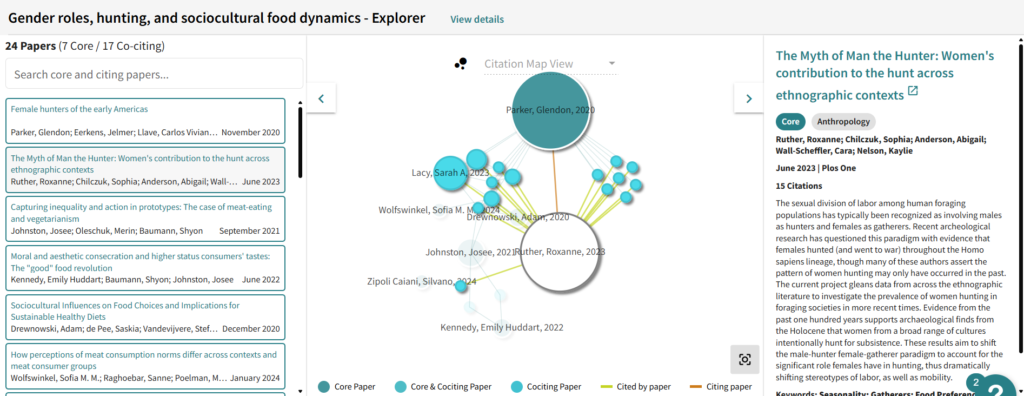
Emerging Topics can be accessed via Research Horizon Navigator via InCites (Benchmarking & analytics). An Emerging Topic is identified by (1) a core of highly cited papers and (2) a frontier of recently papers citing the core (Clarivate). Data is updated monthly with InCites dataset.
For each emerging topic, users can view core and citing papers, network citation maps, mean publication year, interdisciplinary index, and top contributors. Further information on Research Horizon Navigator is available in this video guide by Clarivate.
Research Fronts on InCites Essential Science Indicators
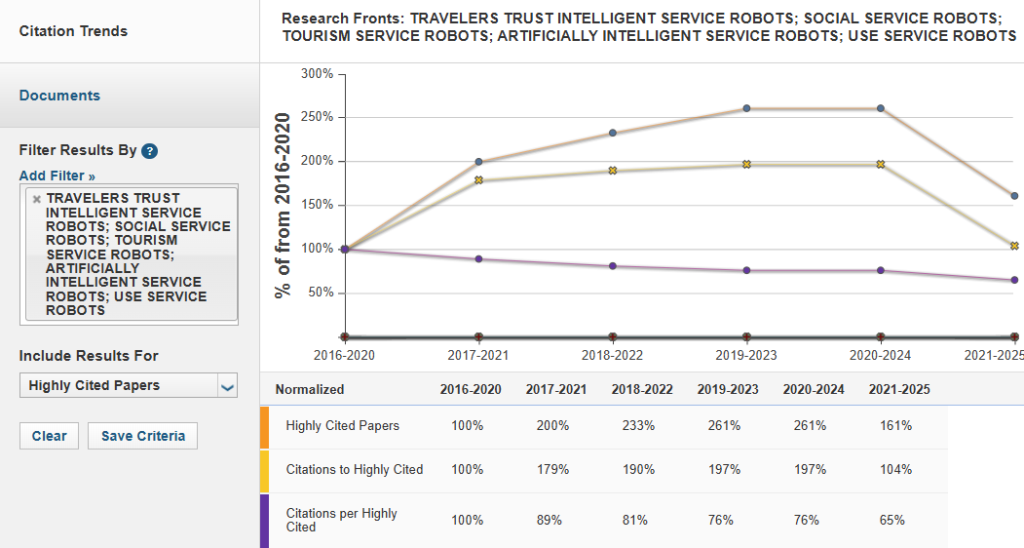
Research Fronts on InCites Essential Science Indicators (ESI) clusters highly cited papers using co-citation analysis (Clarivate). Updates occur bi-monthly.
ESI shows the yearly trend in number of highly cited papers and citations of each research fronts. It also provides the list of highly cited papers currently belonging to the fronts.
Topics on SciVal
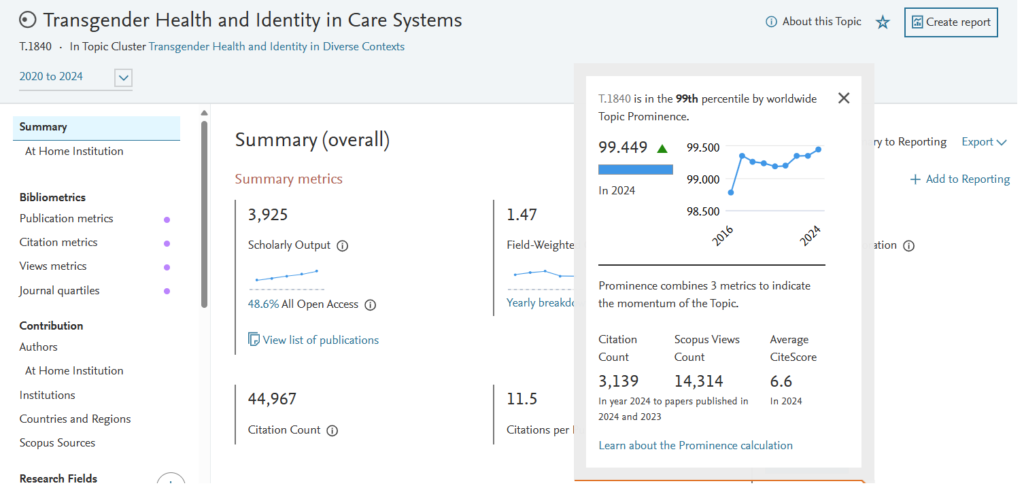
SciVal forms topics using direct citation analysis across all Scopus documents since 1996 (Elsevier). While new publications are constantly added to existing topics, the topics and topic clusters themselves are static unless updated. Our previous blog post discussed the HKU contribution to the newly emerged topics identified in 2024.
Each topic can be analysed as an entity on SciVal. Topic prominence, measured by citation count, Scopus view count, and average CiteScore, serves as an indicator of its momentum. Tracking changes in topic prominence over time reveals emerging trends. View this SciVal guide to learn more about SciVal Topics.
Limitation of citation-based topics
While bibliometric tools are useful for identifying research trends, citation-based clustering has limitations. Papers may be grouped simply because they cite each other, not because they share a coherent theme or research question (Xie & Waltman, 2025). This can lead to misleading associations influenced by methodological lineage or background citations.
There are also other complementary approaches like topic modelling. Text-based techniques analyse the actual content of publications, offering more direct insights and revealing connections that citation metrics may miss.
Cautiously interpreting the topics from InCites Research Horizon Navigator, InCites Essential Science Indicators, and SciVal, researchers can understand emerging trends and make informed decisions for their research.
Extended Readings
- Research Impact — Increasing Research Visibility and Impact
- In the Front of Research: Newly Emerged Topics for 2024 and HKU Contributions
References
Clarivate. Essential Science Indicators Help: Research Fronts. https://esi.help.clarivate.com/Content/research-fronts.htm
Clarivate. InCites Benchmarking & Analytics: Research Horizon Navigator. https://incites.zendesk.com/hc/en-gb/articles/25109512748433-Definitions#h_01HY0Y5XHAESCA7CGWZYAN94AC
Elsevier. SciVal Topics. https://www.elsevier.com/products/scival/overview/topics
Klavans, R., & Boyack, K. W. (2017). Research portfolio analysis and topic prominence. Journal of informetrics, 11(4), 1158–1174. https://doi.org/10.1016/j.joi.2017.10.002
Rotolo, D., Hicks, D., & Martin, B. R. (2015). What is an emerging technology? Research Policy, 44(10), 1827–1843. https://doi.org/10.1016/j.respol.2015.06.006
Shu, F., Julien, C.-A., Zhang, L., Qiu, J., Zhang, J., & Larivière, V. (2019). Comparing journal and paper level classifications of science. Journal of informetrics, 13(1), 202–225. https://doi.org/10.1016/j.joi.2018.12.005
Sjögårde, P., & Didegah, F. (2022). The association between topic growth and citation impact of research publications. Scientometrics, 127(4), 1903–1921. https://doi.org/10.1007/s11192-022-04293-x
Wang, Q. (2018). A bibliometric model for identifying emerging research topics. Journal of the Association for Information Science & Technology, 69(2), 290–304. https://doi.org/10.1002/asi.23930
Xie, Q., & Waltman, L. (2025). A comparison of citation-based clustering and topic modeling for science mapping. Scientometrics, 130(5), 2497–2522. https://doi.org/10.1007/s11192-025-05324-z
Xu, H., Winnink, J., Yue, Z., Liu, Z., & Yuan, G. (2020). Topic-linked innovation paths in science and technology. Journal of informetrics, 14(2), 101014. https://doi.org/10.1016/j.joi.2020.101014