
The Present and Potential of Opening Reference Lists
— by Fanny Liu
“Open citations” (open references) refers to sharing bibliographic references openly, making the information freely accessible and reusable.
Citations are the links between published works and the other works which influence them, usually acknowledged in the reference lists. Scholars analyse citations to study the development of knowledge over time, finding relevant papers and research fronts. Research administrators and funders may use this kind of information to assess academic impact and consider research investments. Traditionally, this has been made feasible with proprietary bibliographic databases, such as Scopus and Web of Science, which require a fee or do not make the data downloadable.
Scholars have been calling for opening citations, as this can support understanding and verification of citation-based analysis, and is important for two key reasons: equity and methodological integrity (Shotton, 2018; Waltman, 2020).

Present
I4OC
The Initiative for Open Citations (I4OC) is a collaboration between academic publishers, researchers, and other stakeholders to promote the unrestricted availability of scholarly citation data (Shotton, 2018).
Many academic publishers register DOIs (Digital Object Identifiers) for their publications with Crossref and potentially, make the metadata openly available. Before I4OC started, only 1% of citation metadata collected annually by Crossref were in the open, while nowadays, several large publishers release reference list metadata publicly, including Elsevier BV, MDPI, SAGE Publishing, Springer Nature, Taylor & Francis, and Wiley (Initiative for Open Citations).

OpenCitations
OpenCitations is an infrastructure organisation for open scholarship (OpenCitations). They use information available from several open matadata sources to build an open citation database, OpenCitations Meta. The sources used includes:
- Crossref
- DataCite
- NIH Open Citation Collection
- OpenAIRE
- Japan Link Center (JaLC)
With the data for citing and cited publications in OpenCitations Meta, a completely open citation index, OpenCitations Index, is built, with 2 billion citations currently.
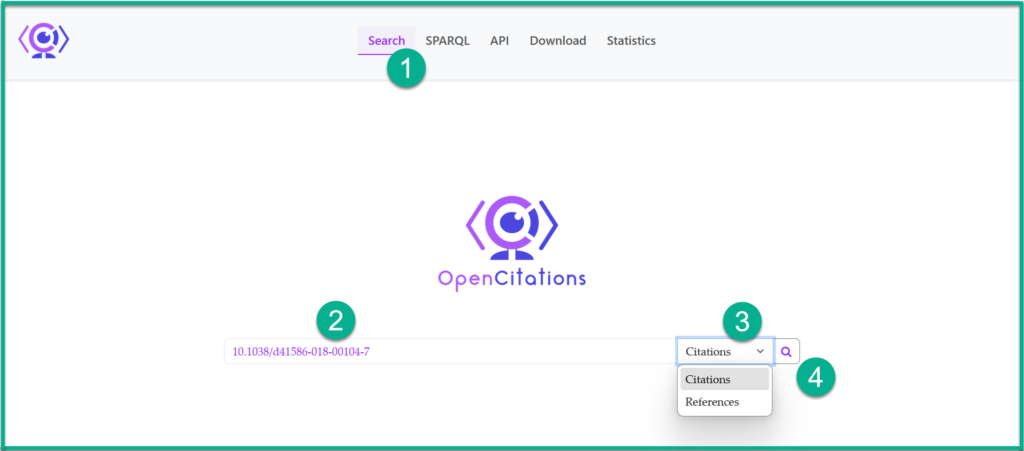
In addition to SPARQL endpoints and REST APIs, OpenCitations has developed search and browsing interfaces that can be used to search the data at: https://opencitations.net/index/search.
Users can enter DOI or PMID (PubMed Unique Identifier), select searching references or citating articles, and search (Figure 1).
The data will benefit researchers, especially 1.) those who cannot afford subscription access to proprietary databases, and 2.) bibliometricians, because open citation data enable the reproducibility of bibliometrics studies (Peroni & Shotton, 2020). The data have also been used by several tools for constructing and visualizing citation networks, such as VOSviewer.
Future
Barcelona Declaration
The Barcelona Declaration on Open Research Information (2025) calls for making openness the default for the research information. At the Paris Conference on Open Research Information in September 2024, the signatories and supporters formulated and prioritized concrete actions, and planned to set-up seven working groups to work on the collective actions in the road map. It advocates for transparency, accessibility, and the sharing of research outputs to advance scientific knowledge and innovation.
Participating publisher
Currently, while larger publishers had a higher percentage of journal articles with an openly available reference list in Crossref, a substantial number of smaller publishers did not submit reference lists to Crossref to make lists openly available (Figure 2) (Van Eck & Waltman, 2025b).
Figure 2: Number of journal articles of a publisher in 2023 and 2024 and percentage of journal articles with openly available references (Created with data by Van Eck and Waltman (2025a))
Research output type
Beyond reference lists of articles, those of more other types of research outputs, for example academic book chapters, can be made open. In 2024, only 29% of the book chapters were with openly available reference lists (Van Eck & Waltman, 2025b). Several publishers, such as De Gruyter and SAGE, and World Scientific, make the reference lists for journal articles openly available, but not those for book chapters.
Bibliographic data
Apart from reference lists, the open availability of other bibliographic data, e.g., abstracts, ORCIDs, author affiliations, funding information, and license information, is an important potential future development. Publishers often make some metadata elements openly available, but not others (Van Eck & Waltman, 2025b). For example, the American Chemical Society makes openly available ORCIDs, author affiliations, funding information, and license information, but not abstracts.

Moving forward, will openness of information about the conduct and communication of research become the standard practice? Researchers and other stakeholders should ponder on this and work together to build a transparent and auditable research system.
Extended Readings
References
Barcelona Declaration on Open Research Information. (2025). Road map on Open Research Information. https://barcelona-declaration.org/roadmap/
Initiative for Open Citations. Participating publishers. Retrieved 26 May 2025 from https://i4oc.org/#publishers
OpenCitations. Home. Retrieved 26 May 2025 from https://opencitations.net/
Peroni, S., & Shotton, D. (2020). OpenCitations, an infrastructure organization for open scholarship. Quantitative Science Studies, 1(1), 428-444. https://doi.org/10.1162/qss_a_00023
Shotton, D. (2018). Funders should mandate open citations. Nature, 533, 129. https://doi.org/10.1038/d41586-018-00104-7
Van Eck, N. J., & Waltman, L. (2025a). Crossref metadata statistics [Data set]. Zenodo. https://doi.org/10.5281/zenodo.14931176
Van Eck, N. J., & Waltman, L. (2025b). Crossref as a source of open bibliographic metadata [Preprint]. MetaArXiv. https://doi.org/10.31222/osf.io/smxe5_v2
Waltman, L. (2020, 22 December). Q&A about Elsevier’s decision to open its citations. Leiden Madtrics. https://www.leidenmadtrics.nl/articles/q-a-about-elseviers-decision-to-open-its-citation
Declaration of Generative AI use
I acknowledge the use of Generative AI tools in writing this post.
I used:
- GPT-4o to brainstorm ideas for the post title.
I declare that I reviewed and edited the contents as needed, and take full responsibility for the contents of the post; And the information provided is complete and accurate.