[Guest Post] Visibility Is Not Disruption: What Citation Networks Reveal about Academic and Industry AI Research
— by Kenny Chow, Nagi Poon
Note: HKU Libraries is committed to fostering the next generation of researchers and advancing research. In our recent collaboration with the Bachelor of Arts and Sciences in Social Data Science (BASc(SDS)) programme, where students tackle real-world challenges in their Final Year Projects, two groups of students explored disruptiveness, i.e., how much a piece of research shifts an existing field of study rather than merely building upon it. Today’s post, the second in the series, is by Kenny Chow and Nagi Poon. Kenny and Nagi were both students in the Bachelor of Arts and Sciences in Social Data Science programme at the University of Hong Kong in 2025-2026.
Since the landmark success of AlexNet in 2012, industry has gained decisive advantages in AI development through large-scale computing infrastructure, proprietary datasets and specialised talent (Ahmed et al., 2023; Besiroglu et al., 2024; Chawla et al., 2023). By 2025, more than 90% of the best-known AI models came from the private sector (Stanford HAI, 2026). These advantages have drawn many academic researchers into collaborations or full-time industry roles, contributing to uneven access to the resources and talent required for frontier AI research (Besiroglu et al., 2024; Jurowetzki et al., 2025; Yamazaki et al., 2022). This raises an important question: does industry’s resource advantage also translate into a stronger role in redirecting subsequent research?
Measuring Visibility and Disruption
To answer this, we examined 399,881 AI-labelled articles and preprints in OpenAlex published between 2010 and 2021. Because the dataset was drawn from a May 2026 snapshot, only part of 2021 had a complete five-year citation window. Papers were classified as purely academic, purely industry, or hybrid (academia–industry).
We measured two distinct forms of impact:
- C₅ – the number of citations a paper receives in its first five years (a measure of attention and visibility).
- DI₅ – the five-year Disruption Index, which asks whether later papers cite the focal work while largely ignoring its own references (disruption) or continue to cite both the paper and its predecessors (consolidation).
Papers were then ranked within their publication year, and those in the top 10% of each metric were identified.
Visibility and Disruption Tell Different Stories
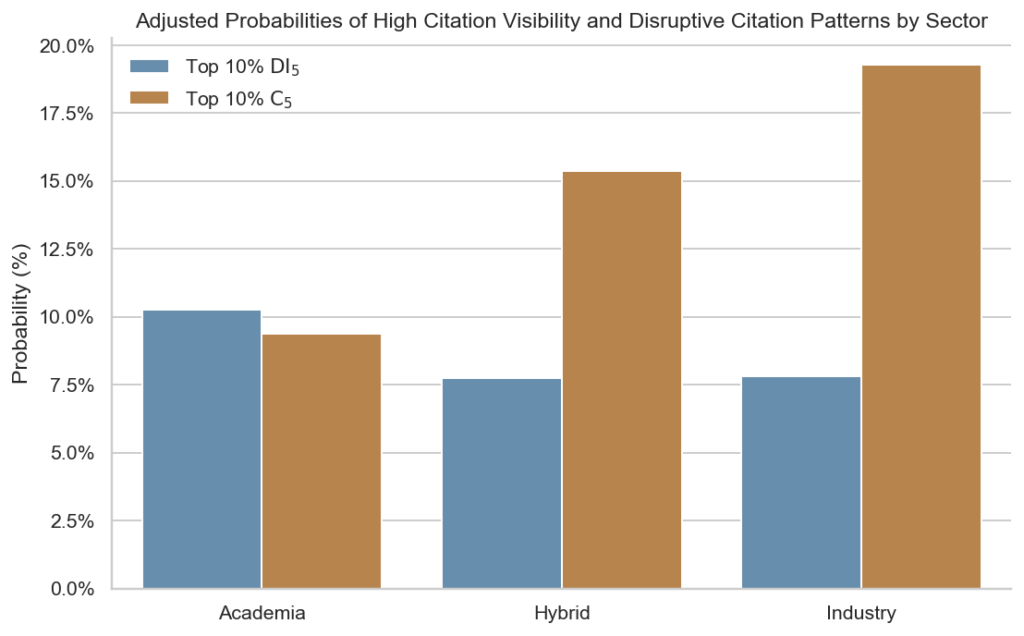
The adjusted results revealed a clear split. The estimated probability of entering the top citation decile was 9.4% for academic papers, 15.4% for hybrid papers and 19.3% for industry papers. For the top DI₅ decile, the corresponding probabilities were 10.3%, 7.8% and 7.8%.
Rethinking Research Impact
Greater citation attention does not necessarily indicate a stronger role in reshaping research directions. In the published record examined, industry involvement was more strongly associated with visibility, while purely academic work was more strongly associated with disruptive citation patterns.
These findings should be interpreted cautiously. DI₅ is not a direct measure of scientific quality, novelty or societal value, and the analysis is associational rather than causal. OpenAlex also captures only published and indexed research. Nevertheless, combining citation visibility with citation-network measures can provide a more balanced understanding of how different institutions contribute to AI knowledge production.
Our poster provides further details, and the processed dataset and derived citation-network resources are openly archived under DOI 10.57967/hf/8850.
Acknowledgements
We would like to express our gratitude to Professor Shihui Feng for her academic guidance, Ir Dr Man Fung Lo for his support, and HKU Libraries colleagues Fanny Liu and Ollie Zhang for their collaboration on this project.
References
Ahmed, N., Wahed, M., & Thompson, N. C. (2023). The growing influence of industry in AI research. Science, 379(6635), 884-886. https://doi.org/10.1126/science.ade2420
Besiroglu, T., Emery-Xu, N., & Thompson, N. (2024). Economic impacts of AI-augmented R&D. Research Policy, 53(7), Article 105037. https://doi.org/10.1016/j.respol.2024.105037
Chawla, S., Nakov, P., Ali, A., Hall, W., Khalil, I., Ma, X., Taha Sencar, H., Weber, I., Wooldridge, M., & Yu, T. (2023). Ten years after ImageNet: a 360° perspective on artificial intelligence. Royal Society Open Science, 10(3), Article 221414. https://doi.org/10.1098/rsos.221414
Stanford Institute for Human-Centered Artificial Intelligence. (2026). The 2026 AI Index report. Stanford University. https://hai.stanford.edu/ai-index/2026-ai-index-report
Jurowetzki, R., Hain, D. S., Wirtz, K., & Bianchini, S. (2025). The private sector is hoarding AI researchers: What implications for science? AI & Society. Advance online publication. https://doi.org/10.1007/s00146-024-02171-z
Yamazaki, T., Miura, T., & Sakata, I. (2022). Big data analysis reveals an emerging change in academia-industry collaborations in the era of digital convergence. 2022 IEEE International Conference on Big Data (Big Data), 6109–6118. https://doi.org/10.1109/BigData55660.2022.10020326