
Is International Collaboration Associated with Higher Citation Impact?
— by Sophia Zhang
Introduction
Research is increasingly conducted across national borders. By bringing together different ideas, resources and outcomes, international collaboration can expand the citation impact of research (Adams, 2013). Bibliometric studies have found that publications co-authored by researchers from multiple countries generally receive more citations than domestic or single-authored publications (Glänzel, 2001; Kwiek, 2021; Wang et al., 2024). However, does international collaboration itself produce this citation advantage, or are other factors also involved?
International Collaboration and Citation Impact
Empirical studies have found that internationally co-authored publications often receive more citations than publications produced through domestic collaboration alone, although the size of this advantage varies across countries and fields (Kwiek, 2021; Wang et al., 2024). One possible explanation is that international collaboration connects researchers and their publications with academic communities in multiple countries, potentially increasing their visibility and circulation. Wang et al. (2024) found that the citation advantage associated with international collaboration involved both citations from abroad and increased visibility within researchers’ home countries. International collaboration may therefore contribute to citation impact by broadening the national and international audiences for research.
Other Influencing Factors
The citation advantage associated with international collaboration should be interpreted cautiously, as it may not result from international collaboration alone. Bibliometric evidence shows that citation impact is associated with team size, with publications produced by larger teams generally receiving more citations than those produced by smaller teams (Larivière et al., 2015). Citation rates also vary across disciplines and are affected by publication age and the citation window used, complicating comparisons across fields and studies (Aksnes et al., 2019). Furthermore, a comprehensive review identified paper-related factors, such as research topic, and journal-related characteristics, including journal impact factor, as the factors associated with citation counts (Tahamtan et al., 2016). These findings demonstrate that citation impact can be shaped by factors beyond the geographical form of collaboration. Team size, disciplinary context, and publication characteristics should therefore be considered when interpreting the citation advantage associated with international collaboration.
From the Literature to the HKU Case
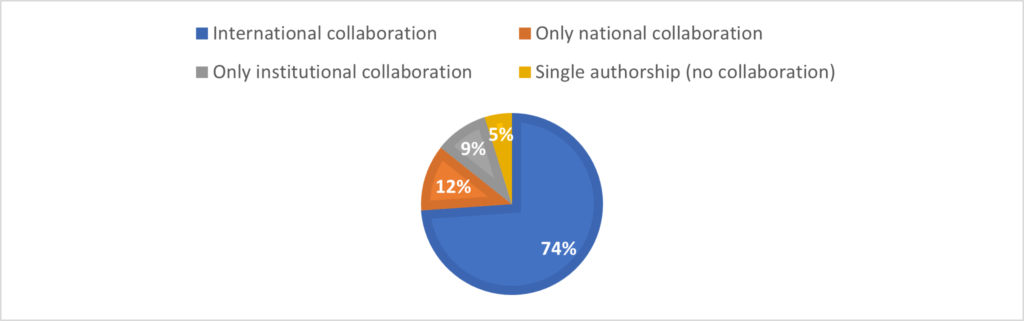
HKU’s recent publication performance provides a useful institutional case for examining whether this general pattern is also visible at the university level. According to SciVal data retrieved in July 2026 for the period 2022–2026, internationally collaborative publications represented 73.9% of HKU’s publication share. These publications produced 32,595 scholarly outputs. They achieved a Field-Weighted Citation Impact (FWCI) of 2.35 (Elsevier, 2026).
An FWCI of 1.00 indicates that a publication or group of publications has been cited at the global average for publications of the same subject field, publication type, and publication year. HKU’s FWCI of 2.35 therefore indicates that its internationally collaborative publications received more than twice the number of citations expected for publications of a similar type, year, and field. Although outputs in every collaboration category performed above the global benchmark of 1.00, internationally collaborative publications had the highest citation impact.
Because the data were retrieved in July 2026, figures for the 2026 publication year should be treated as provisional.
HKU publication and citation performance by collaboration type, 2022–2026
| Metric | Publication Share | Scholarly Output | Field-Weighted Citation Impact |
| International collaboration | 73.9% | 32,595 | 2.35 |
| Only national collaboration | 11.8% | 5,202 | 1.60 |
| Only institutional collaboration | 9.5% | 4,186 | 1.67 |
| Single authorship | 4.8% | 2,141 | 1.23 |
For definitions of geographical collaboration used in SciVal, please refer to their guide at: https://service.elsevier.com/app/answers/detail/a_id/28177/supporthub/scival/
Interpreting HKU’s Citation Advantage
Overall, HKU’s internationally collaborative publications achieved the highest citation impact compared with publications involving national collaboration, institutional collaboration, and single authorship. Because FWCI accounts for differences in subject field, publication year, and publication type, this result cannot simply be explained by internationally collaborative publications being concentrated in highly cited disciplines. However, the figures show an association rather than a direct causal relationship. Further analysis would therefore be needed to determine whether international collaboration itself or other characteristics of these publications contributed to their higher citation impact.
Conclusion
Evidence from previous studies and HKU’s publication and citation data suggest that international collaboration is generally associated with higher citation impact. At HKU, internationally collaborative publications achieved the highest FWCI among the collaboration types. Nevertheless, international collaboration does not guarantee higher citations in every case. Combining citation data with indicators of policy impact, patents, media attention, and community engagement would also provide a more balanced assessment of research influence.
Extended Readings
NSF National Science Foundation: Publications Output: U.S. Trends and International Comparisons | NCSES | NSF
THE Consultancy Report: International Research Collaborations: Motivators, Enablers and Barriers
References
Adams, J. (2013). Collaborations: The fourth age of research. Nature, 497, 557–560. https://doi.org/10.1038/497557a
Aksnes, D. W., Langfeldt, L., & Wouters, P. (2019). Citations, citation indicators, and research quality: An overview of basic concepts and theories. SAGE Open, 9(1). https://doi.org/10.1177/2158244019829575
Elsevier. (2026). SciVal [Bibliometric database]. Retrieved July 18, 2026, from https://www.scival.com
Glänzel, W. (2001). National characteristics in international scientific co-authorship relations. Scientometrics, 51(1), 69–115. https://doi.org/10.1023/A:1010512628145
Kwiek, M. (2021). What large-scale publication and citation data tell us about international research collaboration in Europe: Changing national patterns in global contexts. Studies in Higher Education, 46(12), 2629–2649. https://doi.org/10.1080/03075079.2020.1749254
Larivière, V., Gingras, Y., Sugimoto, C. R., & Tsou, A. (2015). Team size matters: Collaboration and scientific impact since 1900. Journal of the Association for Information Science and Technology, 66(7), 1323–1332. https://doi.org/10.1002/asi.23266
Tahamtan, I., Safipour Afshar, A., & Ahamdzadeh, K. (2016). Factors affecting number of citations: A comprehensive review of the literature. Scientometrics, 107(3), 1195–1225. https://doi.org/10.1007/s11192-016-1889-2
Wang, J., Frietsch, R., Neuhäusler, P., & Hooi, R. (2024). International collaboration leading to high citations: Global impact or home country effect? Journal of Informetrics, 18(4), 101565. https://doi.org/10.1016/j.joi.2024.101565
Declaration of Generative AI Use
I acknowledge the use of Generative AI tools in writing this post.
I used:
- Scopus AI to search for relevant literature.
- GPT-5.6 to summarize previous literature.
- GPT 5.6 to refine the language.
I declare that I reviewed and edited the contents as needed, and take full responsibility for the content of the post; And the information provided is complete and accurate.