
HKU Research in the first half of 2020s: An SDG Perspective
— by Christina Wong
Introduction
The University of Hong Kong continues to advance research that aligns with the United Nations Sustainable Development Goals (SDGs). Given the absence of SDG 17 (Partnerships of the Goals) in Elsevier’s (2024) index due to the difficulty of classification, this article explores insights from bibliometric data of HKU’s scholarly outputs from 2020 to 2025 (data exported on 5-1-2026, with last update on 22-12-2025) across the 16 indexed SDGs from Scopus.
Overview
A total of 21,049 publications is identified as SDG-related out of all 53,376 HKU publications (39.4%) in 2020-2025. The publications have received a cumulative citation count of 631,032 and an average field-weighted citation impact (FWCI) of 2.69. This demonstrates both the breadth and influence of HKU’s research in driving sustainable development.
Scholarly Output by SDG
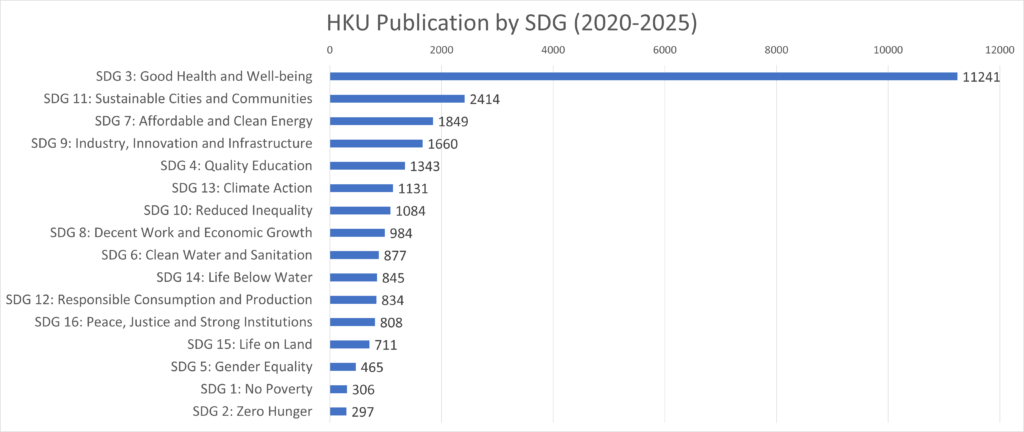
The bar chart below illustrates the number of publications classified into each SDG. With SDG 3 (Good Health and Well-being; 11,241) stands out as the most prominent goal for HKU scholars to study on, it reflects HKU’s strong commitment to health sciences and medical research. Following SDG 3, remarkable proportions of publications fall into the categories of SDG 11 (Sustainable Cities and Communities; 2,414) and SDG 7 (Affordable and Clean Energy; 1,849), reflecting environmental sustainability topics as other foci for HKU research outputs.
Citation Impact of HKU Publications
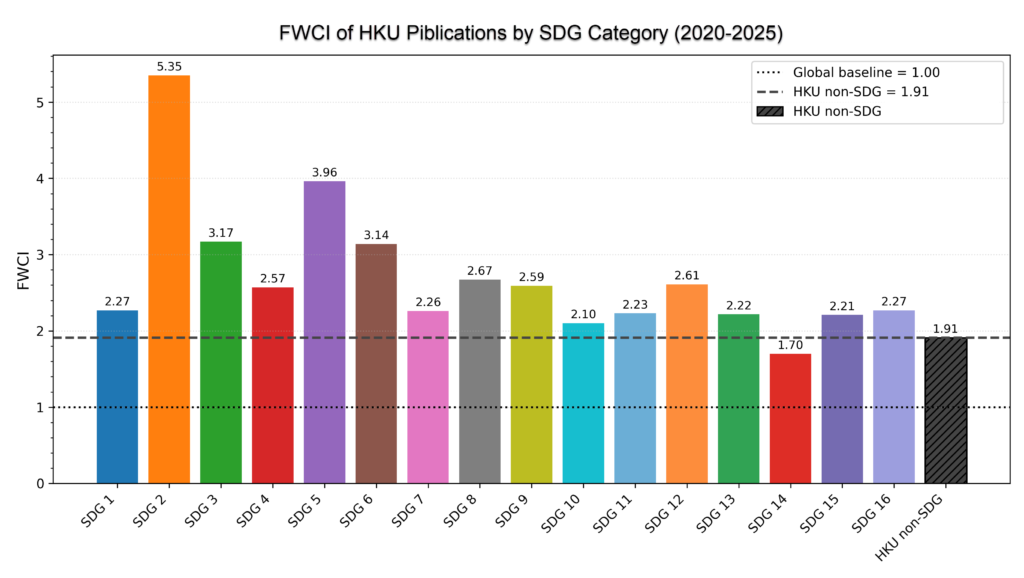
HKU’s research outputs between 2020–2025 demonstrate influence across the Sustainable Development Goals (SDGs). As shown in the table below, HKU publications which are identified with SDG themes achieved a Field Weighted Citation Impact (FWCI) of 2.69, which means that HKU SDG outputs’ citation surpass the global average for similar works (Global baseline = 1.0). Moreover, demonstrating a higher FWCI than HKU publication works without SDG classification, HKU SDG-related publications perform better in terms of citation impact. It shows that the SDG-themed publications are more impactful across the academia in HKU.
On one hand, SDG 3 (Good Health and Wellbeing), being identified as the most popular topic in HKU publication, maintains a prominent research impact by achieving the FWCI of 3.17. On the other hand, with the least publication (297) in 2020-2025 as shown in Figure 1, SDG 2 (Zero Hunger) strives the highest FWCI of 5.35 among all types of HKU SDG publications, revealing the potential of this relatively niche topic in HKU research.
| HKU Publications identified with the 16 SDGs | HKU Publications NOT identified with the 16 SDGs | |
| Number of Publications | 21,049 | 32,327 |
| FWCI | 2.69 | 1.91 |
| Citation Count | 631,032 | 537,386 |
Trending Research Topic clusters
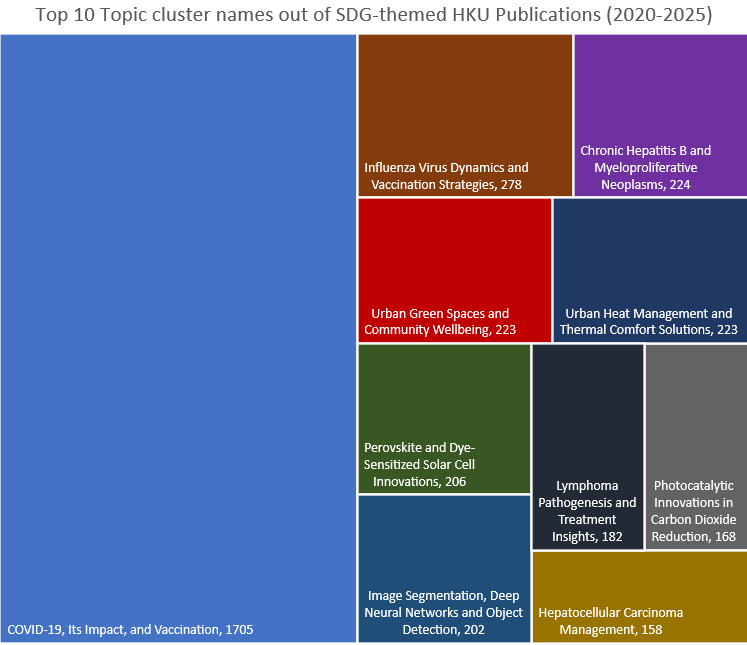
Topic clusters are macro taxonomies of research interest constructed by multiple similar topics. Out of a total of 21,049 HKU research outputs which are identified with SDGs in 2020-2025, The COVID-19 related topic clusters are the most popular, with a total of 1,705 relevant publications. Moreover, HKU scholars also pay attention to public health related topics clusters like “Influenza Virus Dynamics and Vaccination Strategies” and “Chronic Hepatitis B and Myeloproliferative Neoplasms”, contributing 278 and 224 scholarly works respectively. Apart of the attention to public health agendas, topic clusters related to environmental sustainability like “Urban Green Spaces and Community Wellbeing” (223) and “Urban Heat Management and Thermal Comfort Solutions” (223) also come to the HKU researchers’ attention. Notably, the topic cluster “Image Segmentation, Deep Neural Networks and Object Detection” is also one of the top 10 topic clusters. Its popularity echoes with the boom of machine learning and AI technologies.
The distribution of popular topics clusters of SDG-themed publication suggests how HKU scholarship responds to novel global trends, for example, the pandemic, climate change and prevalence of AI technologies. With the knowledge on current research trend, scholars can identify research areas which is more popular and visible, or identify plausible new areas and direction to study on.
Conclusion
HKU’s research portfolio from 2020 to 2025 showcases an impactful contribution to the SDGs. By observing the distribution and trend of the SDG related bibliometric data, researchers can confirm or discover directions on conducting research to create a real change in the world.
Further Readings
- A Review of HKU’s Research Contributions to the Sustainable Development Goals (SDGs) — Researcher Connect
- HKU Contribution to Sustainable Development: Committed, Comprehensive, and Crucial — Researcher Connect
- Viewing HKU Research Through the SDG Lens — Researcher Connect
Reference
Elsevier (2024). Sustainable Development Goals (SDG) FAQs – Simulation Learning System. https://service.elsevier.com/app/answers/detail/a_id/29398/supporthub/evolve-simulations/
Declaration of Generative AI use
I acknowledge the use of Generative AI tools in writing this post. I used:
- Copilot to brainstorm ideas.
- Copilot to analyze the data.
- Copilot to refine the language.
- Copilot to generate figure 1 and 2.
I declare that I reviewed and edited the contents as needed, and take full responsibility for the contents of the post; And the information provided is complete and accurate.