
Tag: bibliometrics and research impact
[Guest Post] Using the Disruptive Index to Benchmark Innovation in AI Research
— by Tsz Chun Brian Lau, Ka Ling Lau Note: HKU Libraries is committed to fostering the next generation of researchers and advancing research. In our recent collaboration with the Bachelor of Arts and Sciences in Social Data Science (BASc(SDS)) programme, where students tackle real-world challenges in their Final Year Projects, two groups of students explored…
Read More
From Indoor Air to Environmental Risk: HKU Environmental Sciences Research in the Global Spotlight
— by Rebecca Tam Environmental sciences research speaks directly to public concerns, from indoor air quality to climate and biodiversity risks. This post examines 3,091 HKU-affiliated environmental sciences outputs published between 2020 and 2024, indexed in SciVal and tracked by Altmetric Explorer. Data were retrieved on 30 April 2026. At a glance What caught the world’s attention COVID-19-related studies on…
Read More
Interdisciplinarity and Citation Impact
— by Fanny Liu Introduction Important questions do not always fit into one academic field. For example, issues such as climate change, AI governance, pandemics, and sustainable cities involve science, technology, society, ethics, and economics. This is why interdisciplinary research is important. It brings together ideas and methods from different fields. By doing this, researchers…
Read More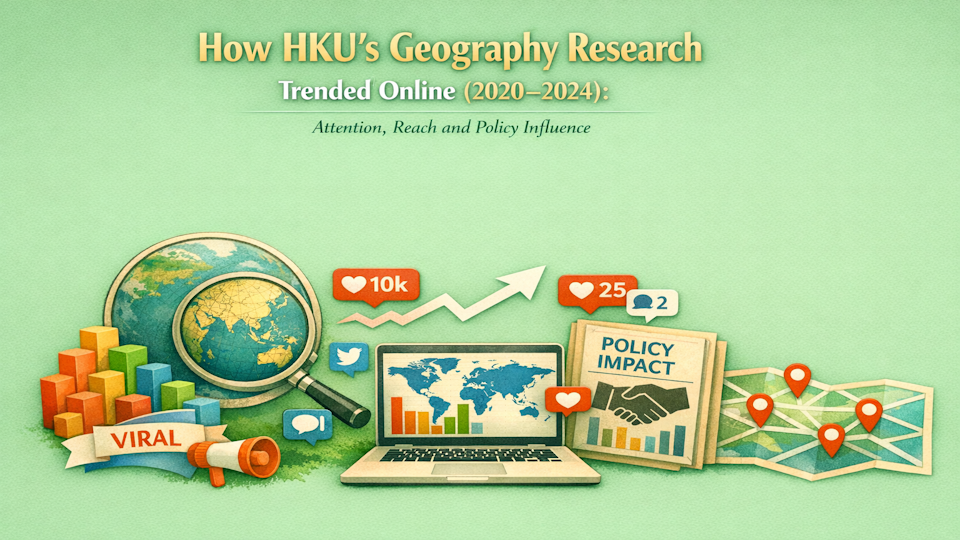
How HKU’s Geography Research Trended Online (2020–2024): Attention, Reach and Policy Influence
— by Kitman Chan We wanted to look beyond traditional metrics to understand the real-world footprint of HKU’s geographical research. In today’s digitally connected world, the academic conversation happens everywhere: on social media, in news headlines, and even in policy rooms from Geneva to Washington. By using Altmetric Explorer and SciVal, we analyzed 1,064 HKU-affiliated geography outputs from 2020 –2024. Below is a summary…
Read More
Evolving Benchmarks – Clarivate’s Highly Cited Researcher Methodology Updates in 2025
— by River Mi HKU’s Performance in 2025 Highly Cited Researcher HKU achieved a new record with 54 scholars named in Clarivate’s “Highly Cited Researchers 2025” list (HCR list) with 38% of Hong Kong Highly Cited Researchers affiliated. In 2025, Clarivate awarded 6,868 individuals worldwide, among whom 145 had primary affiliation in Hong Kong. Behind…
Read More
HeinOnline’s Scholarly Impact Rankings: Another Set of League Tables Based on Citation Counts?
— by Eddie Ko HeinOnline released its Scholarly Impact Rankings (SIR) in late January 2026. HKU staff and students can access SIR via HeinOnline > Law Journal Library database. The steps for access are illustrated in the figure below: An open-access version SIR is also available. While both versions provide the same data, the subscriber…
Read More
Capturing Impacts of Non-Traditional Research Outputs (NTROs)
— by Fanny Liu Introduction to NTROs Non-Traditional Research Outputs (NTROs) are research outputs beyond the traditional research outputs (academic journal articles, conference papers, academic books, and book chapters). They represent a diverse spectrum of creative and practice-based works, reflecting the innovative nature of research, particularly within the humanities and social sciences. For example, in…
Read More
Where Research Is Heading: Identifying Emerging Topics
— by Chloe Ng Identifying emerging research topics helps researchers track areas gaining momentum in their fields. With the growing volume of publications, bibliometric tools help to detect these trends. This blog post outlines what defines an emerging topic, why topic growth matters, and how tools like InCites and SciVal can support this process. What…
Read More
How HKU Medical Research Travelled the World: Attention, Policy Uptake, and Clinical Practice
— by Fanny Liu What happens to research after it’s published? At University of Hong Kong (HKU), medical outputs from 2020–2024 didn’t just circulate in journals—they reached global newsrooms, informed policies, and shaped clinical guidance. Using Altmetric Explorer, we looked at 10,508 HKU-affiliated medical research outputs to understand their online attention and broader influence. Note:…
Read More
HKU Shines in Stanford’s 2025 World’s Top 2% Scientists List
— by Yining Huang, Ollie Zhang, Stella Chow Stanford University released the latest World’s Top 2% Scientists list in mid‑September 2025, recognizing leading researchers worldwide. The ranking is presented in two complementary views: a career‑long assessment that captures cumulative influence from 1960–2024 and a single recent year view that measures research influence during 2024. Together,…
Read More