

Interdisciplinarity and Citation Impact
— by Fanny Liu
Introduction
Important questions do not always fit into one academic field. For example, issues such as climate change, AI governance, pandemics, and sustainable cities involve science, technology, society, ethics, and economics. This is why interdisciplinary research is important. It brings together ideas and methods from different fields. By doing this, researchers can better understand problems, choose suitable ways to study them, create new solutions, and produce knowledge that is useful in real life. It can also help turn research findings into policies and practical actions more quickly.
In addition to addressing the importance of interdisciplinarity in tackling social issues, various scholars also researched its relationship with citation impact.
Interdisciplinarity
OECD (1972, p. 25) defined “interdisciplinary” as an adjective to describe:
Interaction between two or more different disciplines. The interaction may range from simple communication of ideas to the mutual integration of organising concepts, methodology, procedures, epistemology, terminology, data and organisation of research and education in a fairly large field.
Interdisciplinarity and Citation Impact
Research findings on interdisciplinarity’s citation impact are often inconsistent. Highly interdisciplinary papers often show lower early citations due to delayed recognition, yet their impact grows and peaks later.

Short-term
Using data from specific years, all disciplines combined, no statistically significant association between interdisciplinarity and citation rates is found (Larivière & Gingras, 2010). However, in some fields, interdisciplinarity lead to higher citations. In non-citation-intensive disciplines, more interdisciplinarity correlates with higher citation rates. In citation-intensive disciplines, citations decrease as interdisciplinarity increases.
Long-term
Highly interdisciplinary papers experience delayed citation impact—taking longer to reach citation peak—at both paper and aggregate levels, across disciplines and periods (Zhang et al., 2024). From average yearly citation curves, time to reach citation peak is 7 years for high, 5 for medium, and 3 for low interdisciplinarity research.
Research found that papers with higher interdisciplinarity achieve greater average citation impact but require more time to garner academic recognition (Cai et al., 2023; Leahey et al., 2017; Xu et al., 2025). Interdisciplinary articles generally receive significantly more citations in long term (over 10 years) than their uni-disciplinary counterparts.
Aspects of Interdisciplinarity
Researchers also study interdisciplinarity by analysing the three different attributes of a system comprising different categories, namely Variety, Balance and Disparity (Stirling, 2007; Yegros-Yegros et al., 2015).
Variety
Variety refers to the number of categories in a system. It answers the question ‘how many types of things are there?’
Balance
Balance is the evenness of the distribution of categories. This attribute deals with the question ‘how much of each type of things is there?’
Disparity
Disparity refers to the degree to which the categories are different. It addresses the question ‘how different from each other are the types of things?’
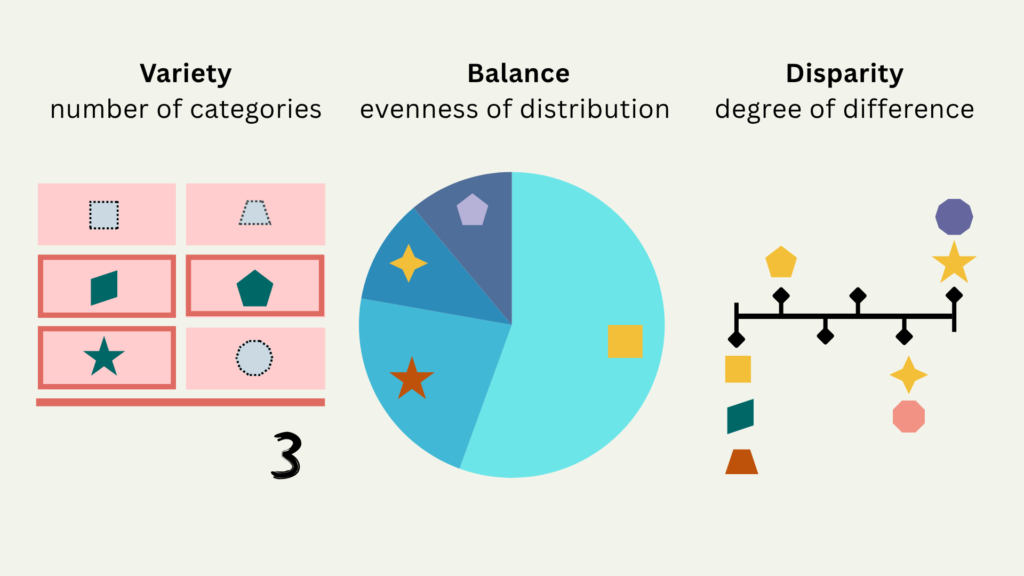
Aspects of Interdisciplinarity and Citation Impact
The relationships between variety, balance, and disparity in relation to citation impact exhibit a complex multifaceted interplay.

Short-term
The three dimensions of interdisciplinarity, variety (categories cited), balance (the distribution of references over categories), and disparity (the cognitive distance of the references), display an inverted U-Shape relationship with citation impact (Yegros-Yegros et al., 2015). Highly cited papers tend to take reference from various other categories (higher variety), but cite little from distant categories (lower disparity) and in small proportions (lower balance).
Long-term
Long term (over 13 years) citations:
- rise at an accelerating rate with variety,
- decline as balance increases, and
- rise but with diminishing returns as disparity grows (Cai et al., 2023).
Although variety and disparity boost long-term citations, they negatively affect short-term (3-year) citations due to delayed recognition.
Conclusion
High interdisciplinarity research shows substantial delayed citation accumulation patterns, and enjoys a long-term citation advantage. Interdisciplinarity can be analysed in three aspects: variety, balance, and disparity. In long term, citations increase at an accelerating rate with variety, decrease as balance grows, and increase with diminishing returns as disparity rises.
Extended Readings
References
Cai, X., Lyu, X., & Zhou, P. (2023). The relationship between interdisciplinarity and citation impact—a novel perspective on citation accumulation. Humanities and Social Sciences Communications, 10(1), 945. https://doi.org/10.1057/s41599-023-02475-3
Larivière, V., & Gingras, Y. (2010). On the relationship between interdisciplinarity and scientific impact. Journal of the American Society for Information Science and Technology, 61(1), 126–131. https://doi.org/10.1002/asi.21226
Leahey, E., Beckman, C. M., & Stanko, T. L. (2017). Prominent but Less Productive: The Impact of Interdisciplinarity on Scientists’ Research. Administrative Science Quarterly, 62(1), 105–139. https://doi.org/10.1177/0001839216665364
Organisation for Economic Cooperation and Development (Centre for Educational Research and Innovation). (1972). Interdisciplinarity: Problems of teaching and research in universities. OECD Publications Center.
Stirling, A. (2007). A general framework for analysing diversity in science, technology and society. Journal of the Royal Society, Interface, 4(15), 707–719. https://doi.org/10.1098/rsif.2007.0213
Xu, J., Zheng, Z., Min, C., Huang, W.-b., & Bu, Y. (2025). Knowledge integration and diffusion structures of interdisciplinary research: A large-scale analysis based on propensity score matching. Journal of the Association for Information Science and Technology, 76(9), 1210–1226. https://doi.org/10.1002/asi.25014
Yegros-Yegros, A., Rafols, I., & D’Este, P. (2015). Does Interdisciplinary Research Lead to Higher Citation Impact? The Different Effect of Proximal and Distal Interdisciplinarity. PLoS ONE, 10(8), e0135095. https://doi.org/10.1371/journal.pone.0135095
Zhang, Y., Wang, Y., Du, H., & Havlin, S. (2024). Delayed citation impact of interdisciplinary research. Journal of Informetrics, 18(1), 101468. https://doi.org/10.1016/j.joi.2023.101468
Declaration of Generative AI Use
I acknowledge the use of Generative AI tools in writing this post.
I used:
- GPT-5.2 to check for grammar mistakes and typos in the content I wrote.
I declare that I reviewed and edited the contents as needed, and take full responsibility for the contents of the post; And the information provided is complete and accurate.